Phrase (Basic ㊦ 325)
A sentence ending which indicates that the speaker is explaining or asking for an explanation about some information shared with the hearer, or is talking about something emotively, as if it were of common interest to the speaker and the hearer.
Equivalent: The explanation is that ~; The reason is that ~; The fact is that ~; It is that ~
| (i) {V/Adjective い} informal | のだ | |
| {話す /話した} のだ | Someone (will) talk/talked | |
| {高い /高かった} のだ | Something is/was expensive | |
| (ii) {Adjective な/N} | {な/だった} のだ | |
| {静かな/静かだった} のだ | Something is/was quiet | |
| {先生な/先生だった} のだ | Someone is/was a teacher |
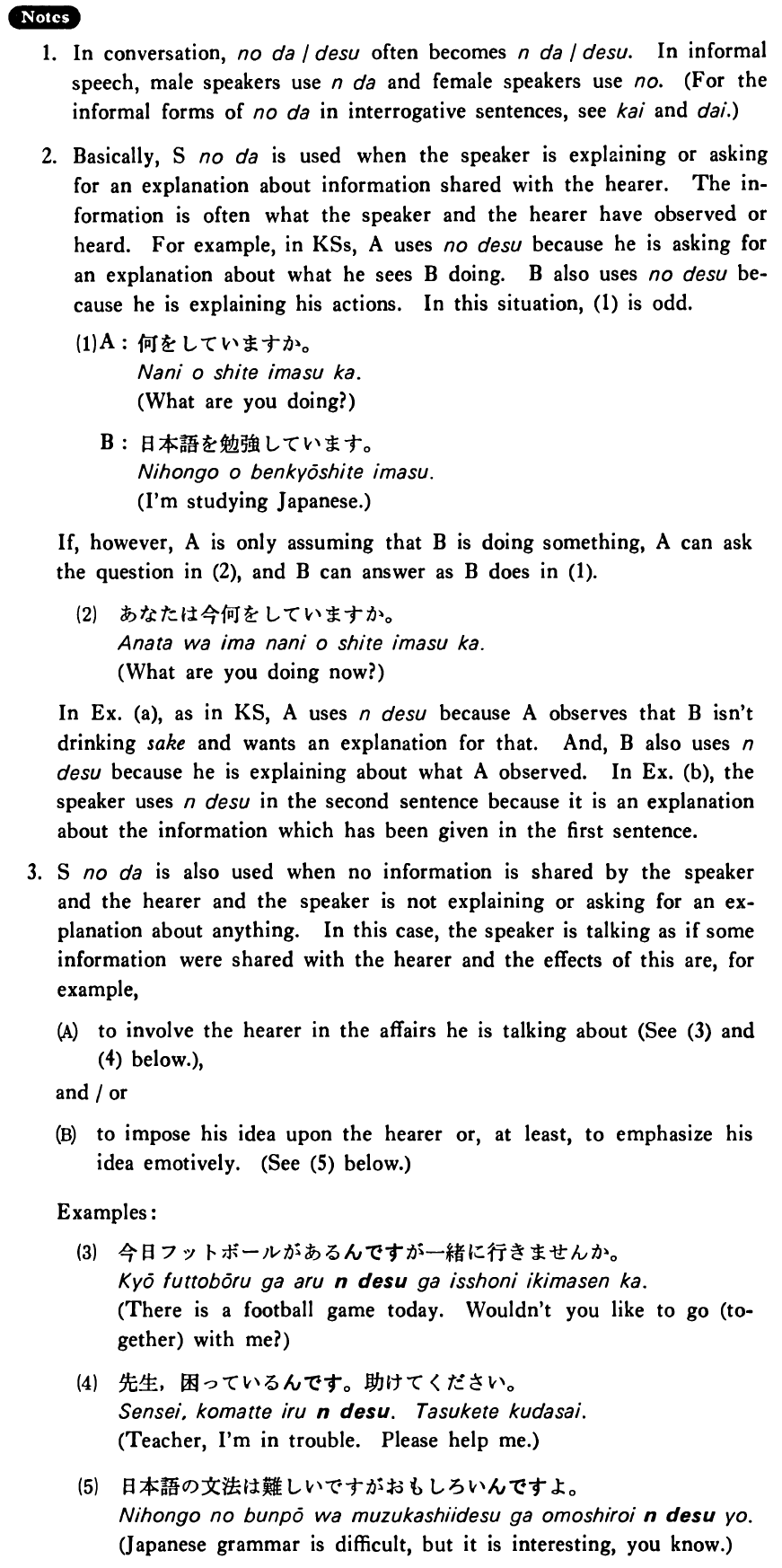
1. In conversation, のだ/です often becomes んだ/です. In informal speech, male speakers use んだ and female speakers use の. (For the informal forms of のだ in interrogative sentences, see かい and だい.)
2. Basically, Sentenceのだ is used when the speaker is explaining or asking for an explanation about information shared with the hearer. The information is often what the speaker and the hearer have observed or heard. For example, in Key Sentences, A uses のです because he is asking for an explanation about what he sees B doing. B also uses のです because he is explaining his actions. In this situation, (1) is odd.
If, however, A is only assuming that B is doing something, A can ask the question in (2), and B can answer as B does in (1).
In Example (a), as in Key Sentence, A uses んです because A observes that B isn't drinking sake and wants an explanation for that. And, B also uses んです because he is explaining about what A observed. In Example (b), the speaker uses んです in the second sentence because it is an explanation about the information which has been given in the first sentence.
3. Sentenceのだ is also used when no information is shared by the speaker and the hearer and the speaker is not explaining or asking for an explanation about anything. In this case, the speaker is talking as if some information were shared with the hearer and the effects of this are, for example,
Examples: